• Photographer now have more challenge

    The comic highlights how dramatically data storage and workflows have evolved for photographers:

    In 2005:

    Photographers used two 500 GB hard drives. The setup looks old-fashioned: a bulky CRT monitor and a single screen. The photographer appears frustrated, likely due to limited storage, slower systems, and heavier file management.

    In 2025:

    A single 20 TB drive replaces multiple smaller ones. The workspace includes dual modern monitors, reflecting a more advanced editing workflow. The photographer seems more relaxed or engaged, possibly due to better performance, faster access, and streamlined file management.

    The overall message: while file sizes have grown, so have storage capacities and efficiencies, making modern photography workflows smoother despite the data explosion.
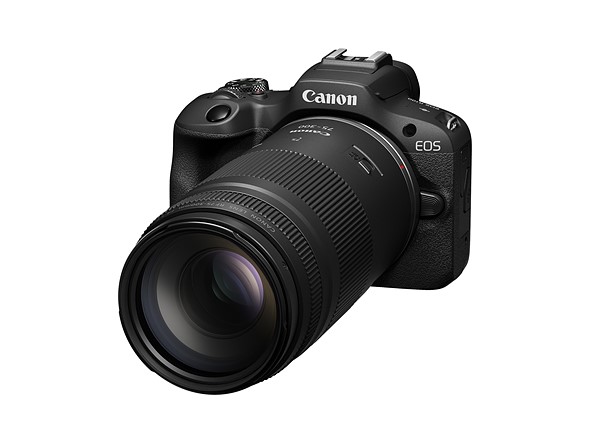
  • Canon has announced an RF-mount version of its 75-300mm F4.0-5.6 low-cost full-frame tele zoom lens. Though there are no details yet of a US release.

    The company says the Canon RF 75-300mm F4.0-5.6 is based on the existing DC-motor version of the EF-mount 75-300mm F4.0-5.6 III, dating from April 1999.

    Like the quarter-of-a-century-old lens, the RF-mount version comprises 13 elements in 9 groups, and has a minimum focusing distance of 1.5m and a maximum magnification of 0.25x, delivered at the 300mm position.

    It has 7 aperture blades, a 58mm filter thread at the front and accepts the same, optional. ET-60 lens hood.

    At 146mm (5.75″) long, the RF-mount version is 24mm longer than the EF-mount version which, not coincidentally, is the difference in flange-back distance between the two mounts. This extra length comes with a 27g increase in weight, taking the new version to 507g (1.11lb).

    The lens will primarily be sold as part of a two-lens kit, giving an affordable way to add a lot of reach to Canon’s RF-mount cameras.

    No details of a US launch have been given, nor has it been explained why it’s not being announced alongside other markets. Speculation that Canon USA might be waiting to see what level of tariffs threatened by the US government end up being imposed was met without comment.

    The EF-mount version currently sells for $199 on its own or, when combined with a shoulder bag, adds $120 to the cost of the EOS T7 APS-C DSLR.

  • Great question — both Rolleiflex and Hasselblad are legendary medium format camera systems, but they serve slightly different needs and design philosophies. Whether one is “better” depends on how you’re defining quality — optics, handling, resolution, reliability, or system flexibility.

    Here’s a breakdown:


    🔍 Rolleiflex (Twin-Lens Reflex – TLR)

    ✅ Strengths:

    • Fixed Zeiss/Schneider lenses (Planar, Xenotar): superb sharpness and contrast
    • Extremely compact for a medium format camera
    • Very quiet and discreet (ideal for street or documentary)
    • Reliable mechanics; minimal electronics
    • Excellent for waist-level, candid photography

    🚫 Limitations:

    • Fixed lens — you can’t change focal lengths
    • Manual everything (focus, exposure, film advance)
    • Not as flexible for studio or telephoto work

    🔍 Hasselblad (500 Series, etc.)

    ✅ Strengths:

    • Modular system: interchangeable lenses, backs, viewfinders
    • Zeiss glass: top-tier optics (Planar, Distagon, Sonnar)
    • Better suited for studio, landscape, and professional commercial work
    • Leaf shutter lenses allow flash sync at all speeds

    🚫 Limitations:

    • Bulkier and heavier than Rolleiflex
    • Louder shutter/mirror slap
    • Some models (older ones) require more maintenance

    📸 Optical Quality

    Both use Zeiss lenses, so image sharpness, contrast, and microcontrast are exceptional in both systems. However:

    • Rolleiflex lenses (Planar 80mm f/2.8) are legendary for their creamy bokeh and sharp center.
    • Hasselblad lenses are more diverse (wide, macro, telephoto) and often edge out Rolleiflex in versatility and optical corrections due to being system lenses.

    🧠 Which Should You Choose?

    CriteriaChoose RolleiflexChoose Hasselblad
    Street/documentary work✅ Quiet, compact, discreet🚫 Bulky, loud
    Studio/fashion/portrait🚫 Fixed lens limits flexibility✅ Modular, flash sync, lens variety
    Weight & portability✅ Lighter and quicker to use🚫 Heavier and bulkier setup
    Lens quality (single lens)✅ Exceptional 80mm lenses✅ Exceptional across focal lengths
    Versatility (system)🚫 Not a system camera✅ Full system: lenses, backs, finders
    Price (used market)🟡 ~$1,000–2,000+ depending on model🟡 ~$1,500–4,000+ depending on config

    🏁 Conclusion

    • If you want simplicity, elegance, and top-tier results in a compact package, go with a Rolleiflex.
    • If you need a professional workhorse for varied formats, Hasselblad is the better investment — especially for studio, commercial, or landscape work.

    Would you like sample images or lens comparisons between the two?

  • Daily writing prompt
    Have you ever been camping?

  • Yes, Adobe Lightroom does use AI to enhance photo quality, particularly through its “Adobe Sensei” AI technology. Here’s how Lightroom leverages AI to improve photos:


    🔍 AI Features in Lightroom:

    1. Enhance Details

    • Uses AI-based demosaicing (through Adobe Sensei) to extract more detail and reduce artifacts in RAW files.
    • Especially helpful for images from high-resolution sensors.

    2. Denoise (AI-powered)

    • Introduced in recent versions, this tool uses machine learning to remove noise from high-ISO images while preserving sharpness and color.

    3. Masking & Selective Edits (AI masks)

    • Automatically detects and selects:
      • Subject
      • Sky
      • Background
    • Allows for fast, accurate localized adjustments without manual brushing.

    4. Portrait Enhancements

    • AI-based skin smoothing, eye enhancement, and whitening tools are available in presets and selective edits.

    5. Auto Settings

    • The “Auto” button uses AI to analyze exposure, contrast, and color, and applies intelligent adjustments based on the photo’s content.

    6. Content-Aware Remove

    • Similar to Photoshop’s content-aware fill, this AI-based healing tool intelligently removes unwanted objects from photos.

    🤖 AI vs Manual Editing

    AI tools can greatly speed up workflow and provide excellent starting points, but professional editors often fine-tune results manually for the best quality.

    Would you like a side-by-side example of a RAW photo enhanced using Lightroom AI tools?

  • Half-frame digital cameras (or their digital equivalents) have a niche but notable market presence for a few key reasons — despite the fact that they’re not as common as full-frame or APS-C digital cameras. Let’s break down why they have a market:


    📸 1. Compact Form Factor

    Half-frame means a smaller sensor (or smaller film area in analog terms), which allows for:

    • Smaller lenses
    • Smaller bodies
    • Lighter weight

    This appeals especially to:

    • Street photographers
    • Travelers
    • Everyday shooters who don’t want the bulk of full-frame setups

    🧠 2. Creative Framing & Storytelling

    In film, half-frame cameras gave you 72 shots on a 36-frame roll — double the economy. While that exact trait doesn’t carry over to digital, the mindset of “shoot more, frame tighter” still resonates:

    • Encourages diptychs, storytelling pairs, or even sequential shots
    • Appeals to analog-inspired creators looking for visual experimentation

    💸 3. Lower Cost (Potentially)

    A smaller sensor means:

    • Lower production cost
    • Possibly more affordable lenses
    • Cheaper entry point for beginners or niche artists

    Note: This is only true if the brand actually prices it accordingly — sometimes niche gear costs more, not less.


    🤳 4. Rise of Vertical Content

    This is a newer twist:

    • Half-frame is vertical by default, which aligns perfectly with Instagram Reels, TikTok, and vertical YouTube Shorts
    • A camera that shoots natively in portrait format appeals to creators optimizing for mobile consumption

    🔄 5. Retro Revival & Nostalgia

    The analog half-frame look (like from the Olympus Pen) has a cult following:

    • Some digital brands emulate that aesthetic
    • Reissues or digital reinterpretations (like the rumored/patented Fujifilm X-Pen or vertical-orientation cameras) are tapping into this nostalgia-driven market

    🧪 6. Experimental Use Cases

    Some creators use half-frame sensors (or equivalents) for:

    • Multiframe storytelling
    • Stitching panoramas
    • Stop-motion or time-lapse where many frames are needed
    • Mimicking 8mm/16mm cinematic looks

    ✅ Bottom Line

    While not mainstream, half-frame-style digital cameras serve a creative, compact, and nostalgia-loving niche. In an era where content is fast, vertical, and visual storytelling is king, these quirky little tools have a surprising amount of relevance — especially for hybrid shooters balancing stills and short-form video.


    Want a breakdown of specific half-frame-style digital models or rumors around upcoming ones?

  • Daily writing prompt
    Write about a time when you didn’t take action but wish you had. What would you do differently?

  • The question of whether a photographer should give RAW files to a client is one of the more debated topics in professional photography, and the answer really depends on context, client expectations, usage rights, and the photographer’s business model. Here’s a breakdown of the key considerations:


    Should a Photographer Give RAW Files to a Client?

    Short answer: Usually, no—but there are exceptions.


    Why Photographers Typically Don’t Provide RAW Files

    1. RAW Files Are Incomplete Work
      • RAW files are the digital negatives—flat, unprocessed, and lacking the photographer’s creative touch.
      • Delivering them is akin to a painter handing over a rough sketch instead of a finished painting.
    2. Creative Control
      • Photographers typically want to retain control over how their work is represented. Giving RAW files opens the door to edits that may not reflect the original vision or quality standards.
    3. Brand Protection
      • A poorly edited RAW file by someone else can misrepresent the photographer’s skill or brand.
    4. File Size and Usability
      • RAW files are large and require special software to open. Many clients don’t have the tools or know-how to work with them.

    When It Might Be Appropriate to Provide RAW Files

    1. Commercial Clients / Agencies
      • When working with creative teams (e.g., ad agencies, magazines), they may request RAWs to do in-house editing to match a specific look or campaign.
    2. Second Shooters or Collaborators
      • If another photographer or creative partner is involved in the project, sharing RAW files might be necessary for consistency across edits.
    3. Client Pays Extra for Licensing
      • Some photographers offer RAW files as a premium add-on, often with a significant markup. It becomes a licensing deal—like handing over full rights to the negatives.
    4. Event Photography (Sometimes)
      • In rare cases, a client may need unedited images quickly for news or social media. Still, JPEGs are usually sufficient unless there’s a specific post-processing need.

    Reasons a Client Might Want RAW Files

    • To have complete control over editing.
    • To future-proof their investment (RAW files can be reprocessed with better software later).
    • For archival purposes, particularly with large companies or institutions.
    • Because they distrust the photographer’s editing style (not ideal, but it happens).

    How to Handle Requests for RAW Files

    • Set expectations in your contract. Be clear about what’s delivered and what isn’t.
    • Educate the client. Explain what RAW files are, why you usually don’t provide them, and what’s included in your post-processing.
    • Offer alternatives. Provide high-res TIFFs or uncompressed JPEGs instead, or show before/after samples to build trust.
    • Charge accordingly. If they insist, treat it as a licensing request, and price it to reflect the release of control and rights.

    TL;DR

    📷 RAW files = digital negatives.
    👎 Usually not given to clients.
    ✅ Exceptions: commercial work, premium licensing, collaborators.
    💡 Always set expectations and explain your reasoning clearly.


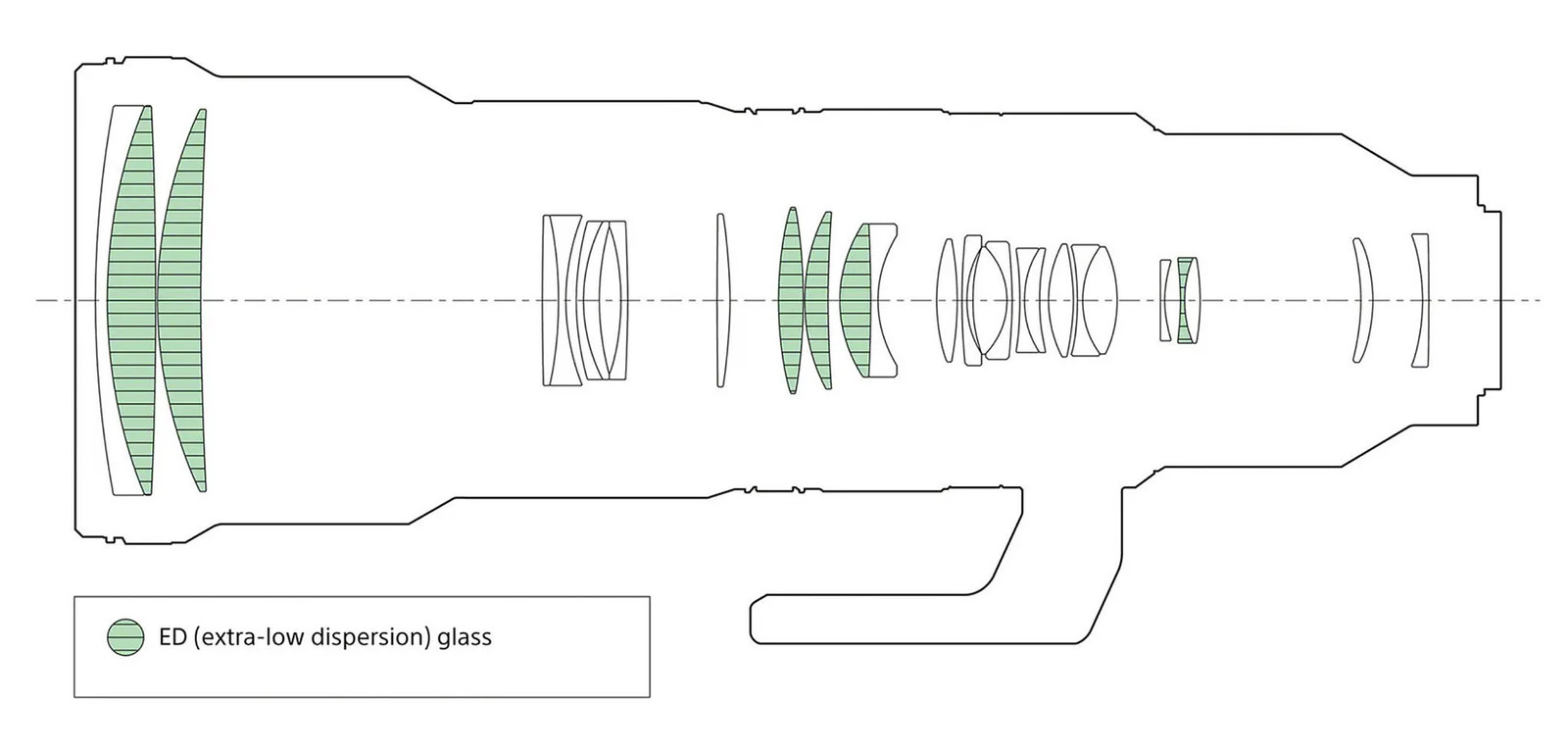
  • This is a lens construction diagram for a Sony 400-800mm super-telephoto zoom lens, likely aimed at wildlife and sports photographers. Let’s break down the design based on what we can see in the optical layout:


    🔍 General Observations

    • Lens Type: Super-telephoto zoom (400–800mm)
    • Construction Style: Internal zooming, front-heavy design (common in long primes/zooms)
    • Tripod Collar: The handle shape on the underside suggests a tripod collar for stability.

    🧠 Optical Element Analysis

    • ED Glass Elements (Green):
      The diagram indicates multiple ED (Extra-low Dispersion) glass elements. These are crucial in reducing chromatic aberration, especially in long telephoto lenses where color fringing can be problematic.
      • Front Group: Two large, paired ED elements right at the front help suppress CA early in the optical path.
      • Middle Group: A cluster of 3 ED elements around the zoom group — this section likely handles the focal length transition from 400 to 800mm.
      • Rear Group: A small ED element is placed in the rear optical group, likely helping correct residual aberrations before the image reaches the sensor.

    🔁 Zoom and Focus Mechanism

    • Zooming Section (Mid-body):
      There’s a symmetrical-looking lens group likely moving back and forth to control focal length. Since it’s a 2x zoom, expect minimal barrel extension or internal zooming — good for weather-sealing.
    • Internal Focus System (Rear):
      Toward the rear, there’s a smaller moving group — probably the focus group — which is common in telephoto designs to avoid moving the front-heavy elements.

    ⚙️ Design Characteristics

    • Modular Grouping: The optical layout is divided into distinct blocks — front (light gathering), middle (zoom control), and rear (focusing and correction).
    • High Correction Priority: The presence of 6+ ED elements suggests a strong emphasis on controlling aberrations and achieving high image clarity across the zoom range.
    • Teleconverter Compatibility: Given the internal space and rear optical design, it’s likely designed to support Sony’s 1.4x and 2.0x teleconverters.

    🎯 Performance Implications

    • Sharpness: With this many ED elements and a complex design, it’s clearly optimized for professional-level resolution, even at 800mm.
    • Bokeh & Contrast: The front group’s large, curved elements will help produce smooth bokeh while maintaining high contrast — vital for isolating distant subjects.
    • Weight Distribution: Most of the heavy glass is in the front half — common for long telephotos — but the internal focusing group near the rear helps balance the lens better on a tripod.

  • Buying a camera in the UK can be a great experience, but depending on your situation, there are a few reasons why some photographers feel it’s not always the best deal — especially compared to places like the US, Japan, or even parts of mainland Europe.

    Here’s a quick breakdown of why buying a camera in the UK might not be the most wallet-friendly move:


    💷 1. Higher Prices (Especially with VAT)

    • The UK includes a 20% Value Added Tax (VAT) in the retail price. That makes cameras noticeably more expensive than in countries where tax is lower or applied differently.
    • Even when prices look comparable at first glance, the UK price usually already includes tax, while US prices often show pre-tax amounts.

    🌍 2. Better Deals Abroad

    • Japan often has better pricing, especially on used or vintage gear — plus a huge secondhand market in excellent condition.
    • US retailers regularly run more aggressive sales, rebates, or bundle deals.
    • Some EU countries (like Germany or Ireland) may offer slightly better prices, particularly during seasonal sales.

    🔁 3. Limited Return Windows or Restocking Fees

    • Some UK stores (especially smaller ones) can be stricter with return policies.
    • Online retailers may have shorter windows or fees, while global sites like B&H or Amazon US often offer more flexibility.

    💸 4. Importing Still Might Be Cheaper (Even with Duties)

    • In some cases, even after shipping and import duty, buying from Japan or the US can still come out cheaper.
    • However, you’ll have to factor in:
      • Import VAT + duties
      • No UK warranty
      • Potential delays or customs holdups

    ⚖️ 5. Weaker Pound vs Other Currencies

    • Currency fluctuations often put UK buyers at a disadvantage when compared to USD or JPY pricing.
    • A strong yen or dollar means imported cameras cost more in GBP.

    That said, buying locally has perks: support from UK retailers, easier returns, warranty coverage, and no customs hassles. It really depends on how much you value peace of mind vs saving cash.